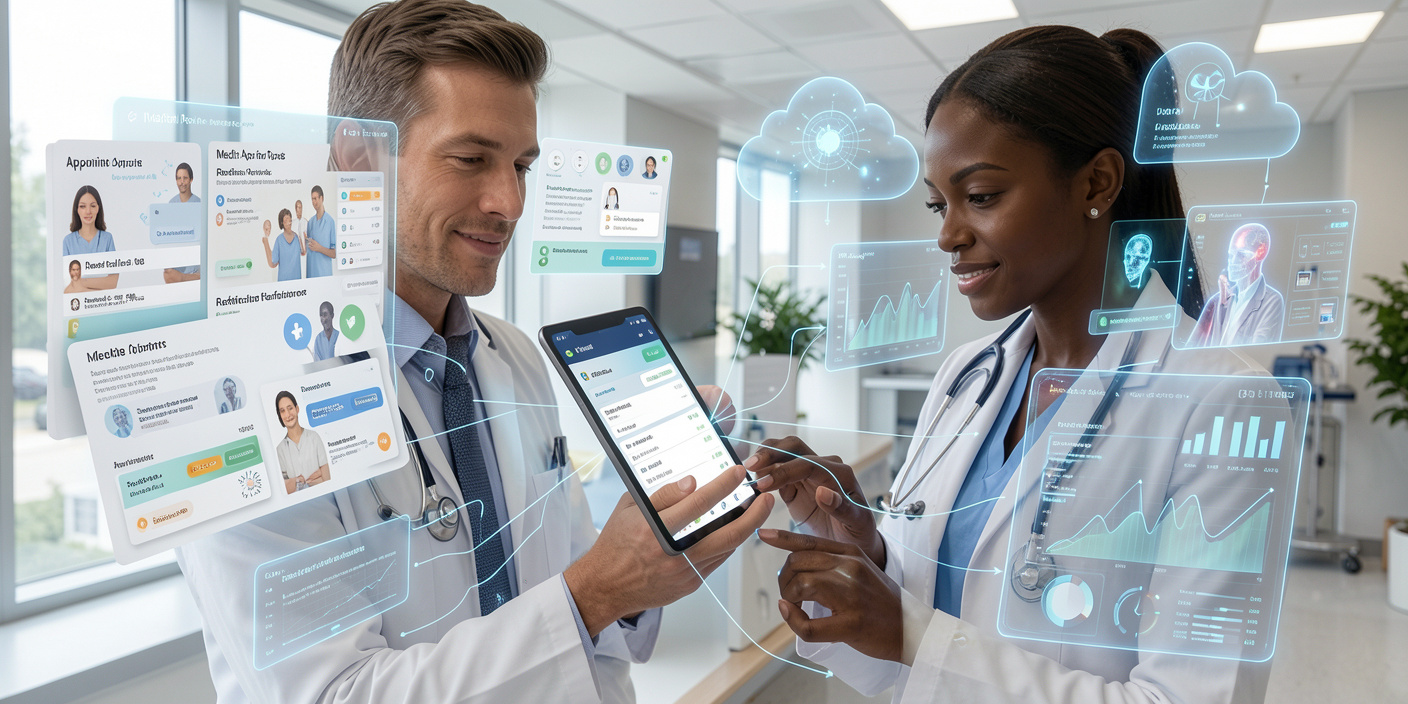
Healthcare is undergoing a significant digital transformation as professionals increasingly rely on connected systems to manage information and daily workflows. Doctors now work with electronic records, digital communication platforms, remote services, and increasingly intelligent software.
Medical apps for doctors are becoming an important part of this changing technology landscape. These applications can help professionals access information, communicate securely, manage appointments, review medical resources, and handle routine administrative activities.
However, the value of an application depends on more than the number of features it provides. Successful healthcare technology needs to fit naturally into professional workflows while maintaining strong security, reliability, and usability.
Accessing Patient Information Digitally
One of the most practical functions of medical applications is providing authorized access to relevant patient information. Depending on the platform, doctors may be able to review medical histories, laboratory results, prescriptions, appointment information, and clinical documentation.
Consequently, digital access can reduce the time professionals spend searching across disconnected systems. When relevant information is available through a well designed interface, doctors can spend more time focusing on patient care and less time navigating technology.
Nevertheless, accessibility must be combined with strong privacy controls. Healthcare applications should protect sensitive information through appropriate authentication, authorization, encryption, and secure data management.
Supporting Communication and Collaboration
Healthcare depends heavily on communication between doctors, nurses, specialists, administrators, and other professionals. Medical applications can provide secure messaging, notifications, appointment updates, and collaboration features.
Moreover, digital communication can help teams coordinate activities across departments and locations. This becomes especially valuable for healthcare organizations operating multiple facilities or supporting remote services.
As a result, medical technology is increasingly becoming part of the broader collaboration infrastructure used by healthcare organizations.
Simplifying Scheduling and Daily Workflows
Administrative work can consume valuable time for medical professionals. Applications can simplify scheduling by providing access to appointments, availability, reminders, and follow up information.
Additionally, workflow management features can help organize routine activities and reduce unnecessary manual processes. Automation can be particularly useful when healthcare organizations need to manage large numbers of appointments and professional interactions.
Technology insights continue to highlight automation as an important driver of digital transformation. In healthcare, its greatest value may come from removing repetitive tasks without reducing professional oversight.
Medical Reference and Learning Tools
Doctors also need access to reliable information throughout their professional activities. Medical applications can provide reference materials, clinical resources, drug information, medical calculators, and educational content.
However, reliability is essential. Developers should ensure that information is appropriately sourced and maintained. Outdated or inaccurate information can reduce trust and create unnecessary risks.
Meanwhile, the broader IT industry news landscape shows increasing adoption of AI powered search and knowledge systems. Similar technologies could make medical reference tools more responsive while still requiring appropriate professional judgment.
Data Analytics and Intelligent Healthcare
Healthcare generates enormous volumes of data. Medical applications can help organize information and provide analytics that reveal patterns in workflows, appointments, system usage, and operational performance.
Furthermore, artificial intelligence can potentially support information retrieval, documentation assistance, and workflow automation. These capabilities are contributing to the evolution of intelligent healthcare platforms.
However, organizations need to implement such technologies carefully. Data quality, privacy, security, governance, and human oversight remain essential as healthcare systems become more automated.
Security Is a Fundamental Requirement
Medical information is highly sensitive, making security a central requirement for healthcare applications. Developers need to consider protection throughout the entire application lifecycle.
Strong authentication can help prevent unauthorized access, while role based permissions can ensure that users see only information appropriate to their responsibilities. Additionally, secure storage and encrypted communication can provide further protection.
As healthcare organizations connect more systems to cloud platforms and mobile devices, the attack surface can also expand. Therefore, security should be built into the architecture rather than added after development.
The Impact on Healthcare Organizations
Medical apps for doctors can influence more than individual productivity. They can also affect organizational operations, employee workflows, technology investments, and service delivery.
HR trends and insights increasingly emphasize the importance of digital skills as organizations introduce new technologies. Healthcare employers may therefore need to provide training so professionals can use applications confidently and effectively.
At the same time, Finance industry updates demonstrate how technology investment is becoming closely connected to operational efficiency. Healthcare organizations must similarly evaluate whether digital tools produce meaningful improvements rather than adopting technology simply because it is new.
Interoperability and the Connected IT Ecosystem
A major challenge for healthcare technology is ensuring that different systems can communicate effectively. An application may provide excellent functionality, but its value can be limited if it cannot work with existing healthcare infrastructure.
Consequently, interoperability should remain an important consideration when evaluating new technology. Connected applications can reduce information silos and create a more consistent digital environment.
Sales strategies and research can also influence how technology providers approach this market. Healthcare organizations increasingly want solutions that demonstrate practical value, integrate with existing systems, and support long term technology strategies.
The Future of Medical Apps for Doctors
The future of medical applications will likely involve greater automation, stronger interoperability, more intelligent analytics, and increasingly personalized user experiences.
Similarly, Marketing trends analysis shows that technology companies are placing greater emphasis on digital experiences and customer trust. Healthcare technology providers will need to communicate their capabilities clearly while demonstrating reliability and security.
The most successful applications are unlikely to be those with the largest number of features. Instead, they will be platforms that solve genuine workflow problems, protect information, integrate effectively, and remain easy for professionals to use.
Practical Insights for Technology Leaders
Medical apps for doctors represent a broader shift toward connected and intelligent healthcare technology. Organizations evaluating these platforms should focus on practical outcomes such as workflow efficiency, secure information access, communication, interoperability, and user adoption.
Developers should also involve healthcare professionals throughout the design process. Their experience can identify practical challenges that may not be visible from a purely technical perspective.
Ultimately, successful healthcare applications will combine strong engineering with thoughtful user experience and responsible data management. As digital transformation accelerates, these principles can help healthcare organizations adopt technology that creates lasting operational value.
Explore iTechInfoPro.com for expert perspectives on technology, innovation, digital transformation, and the evolving IT ecosystem.