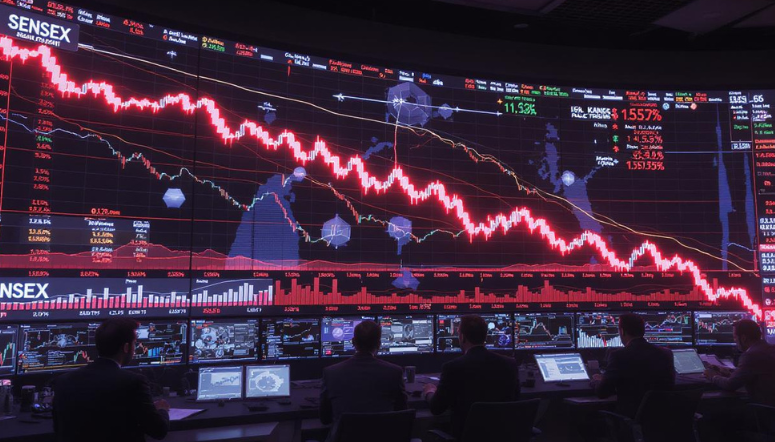
Indian equity markets witnessed a sharp reversal during the final hours of trading as investors rushed to book profits across several sectors. The late sell off dragged benchmark indices lower, with both Sensex and Nifty ending the session down by nearly one percent. At the same time, technology shares faced additional pressure, pushing the IT index lower by around two percent.
The decline came despite relatively stable trading earlier in the day. However, growing concerns about global economic conditions and corporate earnings outlook changed investor sentiment. As a result, traders moved toward a more cautious stance, triggering widespread selling activity across the market.
Why Technology Stocks Faced Greater Pressure
Technology companies were among the hardest hit during the session. Investors remain focused on the health of international markets because a significant portion of revenue generated by Indian technology firms comes from overseas clients. Consequently, any signs of slower economic growth in major markets often create concerns about future demand for digital services.
Moreover, uncertainty surrounding technology spending by global enterprises continues to influence market sentiment. While digital transformation remains a long term priority for businesses, investors are carefully evaluating how economic challenges could affect technology budgets in the near future.
This development has become a major topic within IT industry news as analysts monitor the relationship between global growth expectations and technology sector performance.
Digital Transformation Remains a Long Term Growth Driver
Although market volatility affected technology stocks, the broader story surrounding digital transformation remains strong. Organizations across industries continue investing in cloud platforms, artificial intelligence, cybersecurity, automation, and advanced analytics to improve operational efficiency.
Meanwhile, businesses are accelerating modernization initiatives to remain competitive in an increasingly digital economy. Therefore, temporary market weakness does not necessarily reflect a decline in long term technology adoption trends.
Many industry experts believe that ongoing innovation will continue creating opportunities for technology providers despite short term market fluctuations. These developments are regularly highlighted through technology insights that examine how enterprises are adapting to changing business environments.
Global Trends Influence Local Technology Markets
The technology sector has become deeply connected to global economic trends. Consequently, events taking place in international markets often have a direct impact on investor confidence in domestic technology companies.
Additionally, interest rate expectations, inflation data, and corporate spending forecasts play important roles in shaping technology valuations. When uncertainty increases, investors often become more selective regarding growth oriented sectors.
Similarly, global demand for software services and digital consulting continues to influence revenue expectations for major technology firms. This interconnected environment makes technology markets highly responsive to international developments.
Innovation Continues Despite Market Volatility
While investors reacted negatively during the trading session, innovation across the technology ecosystem remains active. Companies continue exploring emerging technologies that can improve productivity and support long term business growth.
Artificial intelligence solutions, automation platforms, and data driven decision making tools are receiving significant attention from enterprises worldwide. Moreover, organizations are increasingly investing in digital infrastructure to strengthen resilience and improve customer experiences.
In contrast to short term market movements, innovation cycles typically operate over longer periods. Therefore, many technology leaders remain focused on strategic development rather than temporary fluctuations in share prices.
The Impact on Workforce and Business Strategy
Technology sector performance often influences broader business planning. As organizations evaluate growth opportunities, they also consider workforce requirements and operational priorities. Consequently, discussions around HR trends and insights become increasingly relevant during periods of market uncertainty.
Companies continue seeking professionals with expertise in cloud computing, cybersecurity, artificial intelligence, and software engineering. Meanwhile, business leaders are balancing talent acquisition goals with economic realities.
Additionally, finance industry updates remain important for technology firms managing investment plans and expansion strategies. Market conditions frequently shape decisions related to capital allocation and future growth initiatives.
Technology and Market Intelligence Go Hand in Hand
Successful organizations increasingly rely on data driven decision making. Consequently, businesses are paying closer attention to market intelligence, customer behavior, and industry performance indicators.
Sales strategies and research play a crucial role in helping technology companies identify growth opportunities and changing customer demands. Likewise, marketing trends analysis provides valuable insights into how businesses can position products and services more effectively in competitive markets.
As technology becomes more integrated with every aspect of business operations, market developments often provide useful signals regarding future investment priorities and innovation opportunities.
Future Outlook for the Technology Sector
Despite the recent decline that saw Late Sell Off Drags Sensex, Nifty Down 1%; IT Falls 2% become a major market headline, the long term outlook for technology remains encouraging. Digital transformation initiatives continue expanding across industries, creating sustained demand for innovative solutions.
However, investors are likely to monitor economic indicators closely in the coming months. Consequently, technology stocks may continue experiencing periods of volatility as markets react to evolving global conditions.
Businesses that focus on innovation, customer value, and operational efficiency are expected to remain well positioned regardless of short term market fluctuations. Therefore, maintaining a balanced perspective is essential when evaluating developments within the technology ecosystem.
Key Insights for Technology Leaders and Investors
Market corrections often create opportunities to reassess long term technology trends rather than focusing solely on daily price movements. Organizations that continue investing in innovation, workforce development, and digital capabilities are more likely to strengthen their competitive position over time.
At the same time, following technology insights, IT industry news, HR trends and insights, finance industry updates, sales strategies and research, and marketing trends analysis can help decision makers better understand emerging opportunities within an evolving digital landscape.
Explore more expert analysis, technology insights, and innovation focused coverage on iTechInfoPro.com.
Stay informed with the latest developments shaping the future of technology, digital transformation, and the global IT ecosystem.