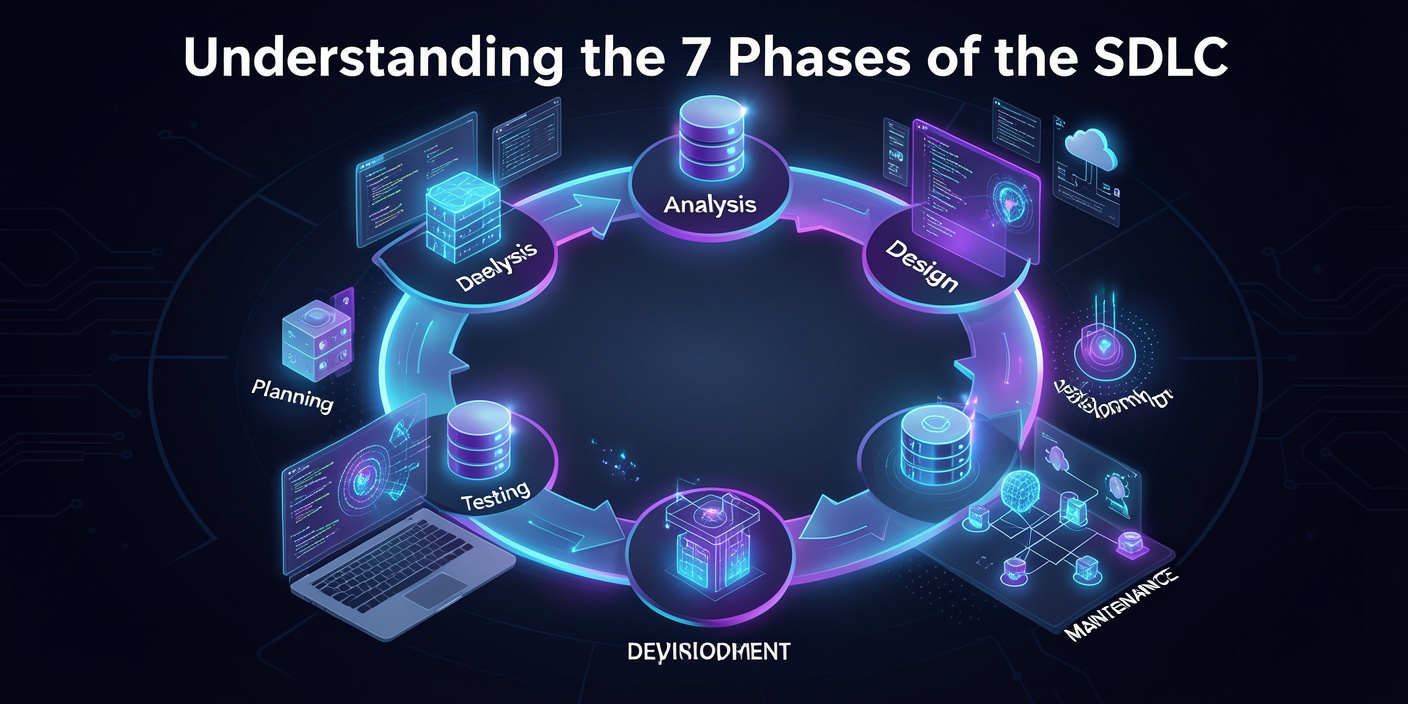
Modern businesses increasingly depend on software to manage operations, serve customers, analyze information, and create new digital experiences. However, successful software development requires more than writing code. It demands planning, collaboration, testing, and continuous improvement.
The SDLC, or Software Development Life Cycle, provides a structured framework for turning an idea into a functional and reliable technology solution. Understanding the 7 phases of the SDLC can help organizations manage development projects more effectively while reducing risks and improving the value of technology investments.
As digital transformation accelerates, this structured approach is becoming increasingly relevant across industries. Technology insights show that organizations need development processes capable of adapting to changing customer expectations, emerging technologies, and evolving business requirements.
What Is the Software Development Life Cycle
The Software Development Life Cycle is a structured process used to plan, develop, test, deploy, and maintain software. Rather than treating development as a single activity, it divides the work into connected phases.
Moreover, the SDLC creates a common framework for developers, project managers, designers, security specialists, business leaders, and end users. Everyone can understand where a project stands, what needs to happen next, and how the final solution should support organizational goals.
Although development methodologies can vary, the underlying objective remains consistent. Teams want to deliver useful, secure, scalable, and reliable software while making efficient use of available resources.
Phase One Planning and Requirements
Every successful technology project begins with a clear understanding of what needs to be achieved. During the planning phase, organizations define project objectives, identify stakeholders, evaluate resources, estimate costs, and establish expected timelines.
Meanwhile, requirements gathering focuses on understanding what users and the business actually need. Teams may examine existing workflows, identify operational problems, and determine the features required from the new solution.
Therefore, strong planning provides a foundation for better decisions throughout the rest of the development process.
Phase Two System Analysis
Once requirements have been gathered, teams analyze them to determine whether the proposed solution is practical. Analysts examine technical requirements, business processes, existing infrastructure, security considerations, and potential challenges.
Additionally, this phase helps organizations identify gaps between their current systems and their desired future state. Teams can then determine which technologies and resources are appropriate for addressing those gaps.
Consequently, careful analysis can prevent expensive mistakes later in development.
Phase Three Software Design
The design phase transforms business and technical requirements into a detailed blueprint for the software. Architects and designers determine how different components will interact and how users will experience the application.
This stage can include database structures, system architecture, interfaces, integrations, security controls, and application workflows. Moreover, user experience becomes increasingly important as businesses compete to provide faster and simpler digital experiences.
In contrast to simply focusing on appearance, effective software design considers usability, performance, security, scalability, and long term maintenance.
Phase Four Development
During development, programmers transform the approved design into working software. They write code, create databases, integrate services, develop interfaces, and connect different system components.
Modern development teams may use cloud platforms, automation, artificial intelligence, version control systems, and collaborative development environments to improve productivity. Furthermore, iterative development allows teams to release smaller improvements and respond to feedback more quickly.
IT industry news continues to reflect how rapidly development practices are evolving as organizations adopt cloud native technologies, automation, and AI assisted development.
Phase Five Testing and Quality Assurance
Before software reaches users, it needs to be carefully evaluated. Testing helps identify defects, performance problems, security weaknesses, compatibility issues, and usability concerns.
Quality assurance teams may test individual components as well as the complete application. Additionally, automated testing can help teams evaluate software repeatedly as new changes are introduced.
Security testing is particularly important in today’s connected environment. Consequently, organizations must consider data protection and application security throughout development rather than waiting until deployment.
Phase Six Deployment
After the software has passed the necessary testing, it can be introduced into the production environment. Deployment may involve configuring infrastructure, migrating information, setting up integrations, training users, and monitoring the new system.
However, successful deployment requires more than making an application available. Businesses must also prepare employees and customers for changes in workflows or digital experiences.
A carefully managed deployment can reduce disruption while providing teams with the information they need to respond quickly if unexpected problems appear.
Phase Seven Maintenance and Evolution
Software development continues after deployment. Applications require updates, security patches, performance improvements, bug fixes, and new capabilities as technology and business requirements change.
Meanwhile, user feedback can provide valuable information about what works well and what needs improvement. Regular monitoring allows teams to identify performance issues and make informed decisions about future enhancements.
As a result, maintenance becomes an important part of digital transformation because technology must continuously evolve alongside the organization.
The SDLC is not limited to software companies. Organizations across healthcare, finance, retail, manufacturing, education, and professional services rely on software to support their operations.
For example, HR departments increasingly use digital platforms to improve workforce management, while finance teams depend on technology for reporting, automation, and data analysis. These developments connect directly with HR trends and insights and Finance industry updates.
Similarly, sales and marketing teams rely heavily on technology to understand customers, manage campaigns, and measure performance. Sales strategies and research increasingly depend on digital data, while Marketing trends analysis helps organizations adapt their customer engagement strategies.
Therefore, a well managed development process can influence business performance far beyond the IT department.
The Future of SDLC in an AI Driven IT Ecosystem
Artificial intelligence is changing how software is planned, developed, tested, and maintained. AI assisted coding tools can accelerate development, while intelligent testing systems can help identify potential issues more efficiently.
Nevertheless, automation does not remove the need for human judgment. Teams still need to understand business objectives, validate technical decisions, manage security risks, and ensure that software delivers genuine value.
Moreover, emerging technologies such as cloud computing, edge computing, automation, and AI will continue to influence development practices. Organizations that combine these technologies with disciplined processes will be better positioned to adapt to changing market conditions.
Practical Insights for Better Software Development
The most effective SDLC approach is one that connects technology decisions with measurable business outcomes. Teams should define clear requirements, communicate regularly with stakeholders, prioritize security, and test continuously.
Furthermore, organizations should treat feedback as an ongoing source of improvement rather than something collected only after launch. Monitoring real world performance can reveal opportunities that were difficult to identify during initial development.
Ultimately, understanding the 7 phases of the SDLC gives organizations a practical framework for managing technology projects from initial concept to continuous improvement. As software becomes increasingly central to business operations, this structured approach can help companies innovate with greater confidence.
Explore More Technology Insights
Technology continues to reshape how organizations operate, compete, and innovate. Staying informed can help decision makers recognize opportunities before emerging trends become mainstream.
Explore more expert technology insights, digital transformation perspectives, and evolving IT developments on iTechInfoPro.com.